When Will Mt Adams Erupt Again
Mount Adams is a potentially active volcano located 50 km east of Mount St. Helens, and is the second highest peak in Washington State. Although it has non had a major eruption in 1,400 years, information technology is not considered extinct. Thermal anomalies and gas emissions at the summit indicate that Mount Adams is notwithstanding active.
Except for Mountain Shasta, Mount Adams is the largest volcano in the Cascades past volume. Nearly all of its eruptions accept consisted of lava flows with picayune to no tephra. Parts of the main cone consist of rock weakened past hydrothermal alteration. There is potential for large landslides of this altered rock to generate mud flows and lahars that flow far down valleys.
Mount Adams Seismicity
Below you lot volition find an epicenter map, a time-depth plot and a count of earthquakes plot for the immediate Mount Adams surface area. These plots are for the time period since 1972. All the same, it was non until the 1980s when there were seismograph stations near enough to locate earthquakes at Mountain Adams. The only station located on Mountain Adams, ASR was installed in the summer of 1982. Compared to many of the other Cascade volcanoes Adams has ane of the lowest rates of seismicity. There is some significant seismicity to the northwest off this map but it is not considered related to Mountain Adams in any style.

Below is a fourth dimension-depth plot of events located directly nether Mount Adams since 1972. This plot is updated weekly... unless, of course unusual activity takes place that suggests a different time sequence is needed to better interpret that activity.

Here is a seismicity plot that shows the number of located earthquakes per calendar week (black spikes) and the cumulative number of earthquakes over fourth dimension (blood-red).

Debris Avalanche at Mount Adams, Washington
Seismic recordings of the 10/twenty/97
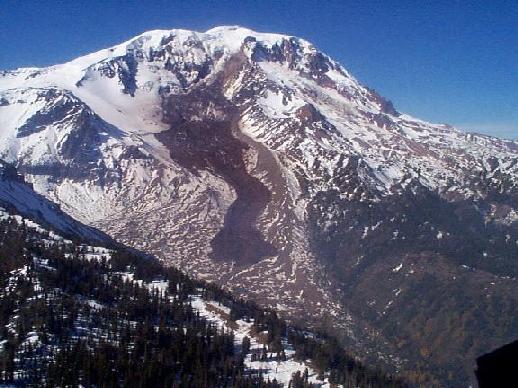
Photo courtesy of Gifford Pinchot National Forest
At 12:31 AM PDT on October twenty, a large mass of rock fell from the Castle, a prominent stone germination e of the meridian of Mount Adams. This barrage was recorded on many seismograph stations of the Pacific Northwest Seismic Network in southern Washington and northern Oregon, and some examples of the seismic signal from five wide-ring stations are shown below. The table below the signals indicates where each of the stations are located, and their distance from the avalanche source area on Mount Adams.
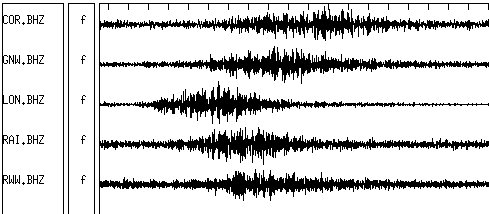
| Station | Location | Altitude, km |
| COR | Corvallis, Oregon | 230 |
| GNW | Dark-green Mtn., Washington | 183 |
| LON | Longmire, Washington | 66 |
| RAI | Trojan Ability Establish, Oregon | 110 |
| RWW | Satsop, Washington | 180 |
The total time window shown is 195 seconds; the signals shown accept durations between 80 and 110 seconds. The total time duration of movement for this barrage is estimated to exist about vi minutes, based on recordings from the closest seismograph station (non shown). The elongated, spindle-like shape of the signals is typical of large avalanches; this characteristic shape helps seismologists to differentiate them from earthquakes, which typically display one or more sharp peaks in amplitude, after which the signal decreases smoothly back to the level of background "noise" typically seen at each station.
According to the USGS Cascade Volcano Observatory (CV) this barrage originated at about xi,200 ft. acme on the south confront of The Castle, a prominent topographic knob at the caput of Battlement Ridge. The source area forms an obvious, near-vertical scar roughly triangular in shape with sides about 300 meters in length. The avalanche traveled across the end of the Klickitat Glacier and continued roughly 2 kilometers downward the valley of Big Muddy Creek, a tributary of the Klickitat River. The length of the barrage runway totals about 5 kilometers, with an average width of .5 km. The volume of debris is estimated to be between 1 and five million cubic meters. The barrage deposit temporarily blocked the menstruation of Large Muddied Creek, avalanche debris. By noon on Oct 21 the avalanche dam had breached, and flow in Large Dingy Creek did non appear unusual.
Avalanches in late August, 1997
The droppings avalanche on October 20 followed an earlier sequence of debris avalanches from the Avalanche Glacier on the southwest side of Mount Adams. These avalanches occurred betwixt August 29 and 31, and consisted mostly of ice from the Avalanche Glacier. In late August, 1997, a section of the Barrage Glacier 1 km long and 300m wide detached from the upper southeast slope of Mount Adams, generating a large droppings avalanche. The avalanche descended the glacier and connected into the heads of Common salt and Mud Creeks below timberline, leaving a deposit with an average length of 4 km, exceeding 5 km in places. Field observations fabricated by geologists from the Cascade Volcano Observatory (CVO) indicate that the barrage deposit consisted mostly of glacier ice and snowfall, blanketed by a veneer of sand, clay, and stone debris scoured from hydrothermally altered stone underneath the glacier. The bulk volume of the deposit is estimated to be approximately 5 million cubic meters.
The avalanche generated three seismic signals, indicating that glacier ice and rock debris vicious from the Avalanche Glacier at least three times- first at 0035 PDT on 8/30, and again a day later at 0631 and 0635 PDT on 8/31. These times concur with reports from hikers, ane of whom witnessed the fall of the largest avalanche at 0635. Although they are visible on helicorder records from most stations in southern and cardinal Washington and northern Oregon, these low amplitude signals were not digitally recorded, and were non recognized by seismologists until a search was made for them after the barrage. The most distant station on which the signal is visible is JCW, 224 km from the avalanche source. The point amplitudes and durations increased during the sequence from an average of 60 seconds and 1mm for the first event to 110 seconds and 2mm for the third. The increment in signal size with fourth dimension indicates that each successive pulse of the barrage was larger in volume.
The cirque that contains the upper Avalanche Glacier has been the source of two other big avalanches since 1900. An avalanche in 1921 left a eolith of 5 million cubic meters of altered rock debris on the southeast slope of the mountain, and a previous plummet of the upper Avalanche Glacier on July 15, 1983 left a deposit of icy rubble similar to but smaller than the Baronial 1997 eolith.
For more than images and detailed information on the Mount Adams avalanches, meet the web pages produced by the Cascades Volcano Observatory.
For more than data on the seismic signals generated past big avalanches, encounter Seismic detection and location of droppings avalanches.
Source: https://pnsn.org/volcanoes/mount-adams
0 Response to "When Will Mt Adams Erupt Again"
Post a Comment